Now and Again Salt Lake City Ut
| Great Common salt Lake | |
|---|---|
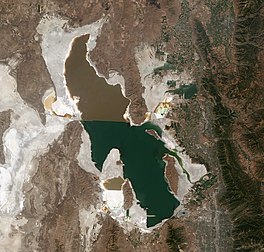 Satellite photograph from Baronial 2022 after years of drought, reaching most-record lows. Note the difference in colors between the northern and southern portions of the lake, the outcome of a railroad causeway. | |
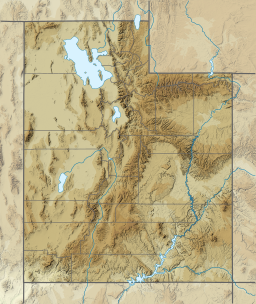
| Great Salt Lake Prove map of Utah Not bad Salt Lake Show map of the U.s.a. | |
| Location | Utah, Usa |
| Coordinates | 41°ten′N 112°35′W / 41.167°N 112.583°W / 41.167; -112.583 Coordinates: 41°10′N 112°35′Due west / 41.167°North 112.583°Westward / 41.167; -112.583 |
| Blazon | Endorheic, hypersaline |
| Primary inflows | Bear, Jordan, Weber rivers |
| Catchment area | 21,500 sq mi (55,685 km²) |
| Basin countries | United States |
| Max. length | 75 mi (120 km) |
| Max. width | 28 mi (45 km) |
| Surface area | 1,700 sq mi (four,400 km²) |
| Average depth | 16 ft (4.9 thou), when lake is at average level |
| Max. depth | 33 ft (ten chiliad) average, high of 45 ft (14 chiliad) in 1987, low of 24 ft (7.iii 1000) in 2021 |
| Water volume | 15,338,693.half dozen acre⋅ft (xviii.92 km3) |
| Surface elevation | historical average of 4,200 feet (1,283 m), four,190.5 feet (ane,279.viii m) every bit of 2022 March 14 |
| Islands | 8–15 (variable, run into Islands) |
| Settlements | Table salt Lake and Ogden metropolitan areas |

The Great Salt Lake is the largest saltwater lake in the Western Hemisphere,[1] and the eighth-largest terminal lake in the globe.[2] It lies in the northern role of the U.Southward. land of Utah, and has a substantial impact upon the local climate, particularly through lake-effect snowfall. It is a remnant of Lake Bonneville, a prehistoric body of water that covered much of western Utah.
In an average year the lake measures approximately 1,700 foursquare miles (4,400 km2),[2] but its area can fluctuate substantially due to its low boilerplate depth of 16 anxiety (iv.9 m). In the 1980s, it reached a historic high of 3,300 square miles (8,500 km2) and the W Desert Pumping Project was established to mitigate flooding by pumping water from the lake into the nearby desert. In 2021, after years of sustained drought and increased water diversion upstream of the lake, it fell to its everyman recorded area at 950 square miles (2,460 km²), falling beneath the previous depression prepare in 1963.[2] [3]
Its 3 major tributaries, the Jordan, Weber, and Acquit rivers together deposit effectually 1.ane million tons of minerals in the lake per year.[1] Having no outlet likewise evaporation, these minerals accumulate and give the lake very high salinity (far saltier than seawater) and density. This density causes swimming in the lake to feel like to floating.
Information technology has been called "America's Dead Sea",[4] and provides a habitat for millions of native birds, brine shrimp, shorebirds, and waterfowl, including the largest staging population of Wilson'southward phalarope in the world.[5]
Origin [edit]
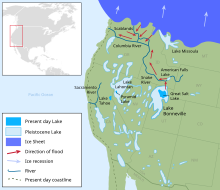
The Groovy Common salt Lake is a remnant of a much larger prehistoric lake chosen Lake Bonneville. At its greatest extent, Lake Bonneville spanned 22,400 square miles (58,000 kmtwo), nearly every bit big equally nowadays-day Lake Michigan, and roughly 10 times the area of the Swell Common salt Lake today.[ii] Bonneville reached 923 ft (281 thou) at its deepest point,[6] [7] and covered much of present-day Utah and pocket-sized portions of Idaho and Nevada during the ice ages of the Pleistocene Epoch.
Lake Bonneville existed until most sixteen,800 years ago, when a large portion of the lake was released through the Cherry-red Rock Pass in Idaho, resulting in cataclysmic floods. With the warming climate, the remaining lake began to dry, leaving the Great Salt Lake, Utah Lake, Sevier Lake, and Rush Lake behind.[6]
History [edit]
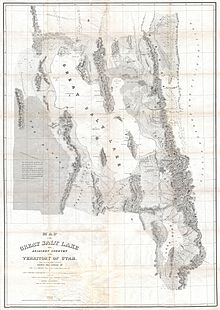
The Shoshone, Ute, and Paiute have lived about the Corking Salt Lake for thousands of years. At the fourth dimension of Table salt Lake City's founding, the valley was within the territory of the Northwestern Shoshone;[8] however, occupation was seasonal, near streams emptying from canyons into the Salt Lake Valley. Ane of the local Shoshone tribes, the Western Goshute tribe, referred to the lake equally Pi'a-pa, pregnant "big water", or Ti'tsa-pa, significant "bad water".[9] [10]
The Great Salt Lake entered written European history through the records of Silvestre Vélez de Escalante, who learned of its existence from the Timpanogos Utes in 1776. No European name was given to information technology at the time, and it was non shown on the map by Bernardo Miera y Pacheco, the cartographer for the trek. In 1824, it was observed, apparently independently, by Jim Bridger and Etienne Provost. Shortly thereafter other trappers saw it and walked effectually information technology. However, there are several maps dating all the way dorsum to 1575 that show the Corking Salt Lake at the right latitude and longitude, within an accurateness of only a few degrees. The most obvious example is a map by Nicolas Sanson dated 1650.[xi]
Most of the trappers, nevertheless, were illiterate and did not tape their discoveries. As oral reports of their findings fabricated their way to those who did brand records, some errors were made. Escalante had been on the shores of Utah Lake, which he named Laguna Timpanogos. It was the larger of the two lakes that appeared on Miera'due south map. Other cartographers followed his lead and charted Lake Timpanogos as the largest (or larger) lake in the region. Equally people came to know of the Great Common salt Lake, they interpreted the maps to think that "Timpanogos" referred to the Nifty Salt Lake. On some maps the two names were used synonymously. In fourth dimension "Timpanogos" was dropped from the maps and its original association with Utah Lake was forgotten.
In 1843, John C. Fremont led the first scientific expedition to the lake, merely with winter coming on, he did not take the time to survey the entire lake. That happened in 1850 nether the leadership of Howard Stansbury (Stansbury discovered and named the Stansbury mount range and Stansbury island).[12] John Fremont'southward overly glowing reports of the surface area were published before long after his expedition. Stansbury also published a formal report of his survey piece of work which became very popular. His written report of the area included a discussion of Mormon religious practices based on Stansbury'due south interaction with the Mormon customs in Cracking Salt Lake City, which had been established three years earlier in 1847.[13]
Outset in November 1895, artist and author Alfred Lambourne spent 4 months living on the remote Gunnison Island, where he wrote a book of musing and poetry, Our Inland Body of water. From Nov 1895 to March 1896, he was alone. In March, a few guano sifters arrived to harvest and sell the guano of the nesting birds as fertilizer. Lambourne included musings virtually these guano sifters in his piece of work. Lambourne left the isle early on in the winter of 1896 along with the first group of guano sifters.[14]
Geography [edit]

The Great Common salt Lake lends its proper noun to Common salt Lake Metropolis, originally named "Great Table salt Lake Urban center" by the president of The Church building of Jesus Christ of Latter-twenty-four hours Saints (LDS Church), Brigham Immature,[15] who led a group of Mormon pioneers to the Salt Lake Valley southeast of the lake on July 24, 1847.
The lake lies in parts of five counties: Box Elderberry, Davis, Tooele, Weber, and Salt Lake. Table salt Lake City and its suburbs are located to the south-e and east of the lake, betwixt the lake and the Wasatch Mountains, but land around the northward and west shores is well-nigh uninhabited. The Bonneville Salt Flats are to the west, and the Oquirrh and Stansbury Mountains ascent to the s.
The Great Salt Lake is fed by three major rivers and several small streams. The 3 major rivers are each fed direct or indirectly from the Uinta Mountain range in northeastern Utah. The Bear River starts on the n slope of the Uintas and flows n past Bear Lake, into which some of Behave River's waters have been diverted[16] via a human being-made canal into the lake, but later empty dorsum into the river by means of the Deport Lake Outlet. The river then turns southward in southern Idaho and somewhen flows into the northeast arm of the Not bad Salt Lake. The Weber River also starts on the n slope of the Uinta Mountains and flows into the east border of the lake. The Hashemite kingdom of jordan River does not receive its h2o straight from the Uintas, rather it flows from freshwater Utah Lake, which itself is fed primarily by the Provo River; the Provo River does originate in the Uintas, a few miles from the Weber and Carry.[6] The Jordan flows from the north part of Utah Lake into the south-east corner of the Keen Common salt Lake.
Due to its shallowness, the h2o level tin fall dramatically in dry years and rising during high-atmospheric precipitation years, thereby reflecting prolonged drought or wet periods. The change in the level of lake level is strongly modulated by the Pacific Sea through atmospheric circulations that fluctuate at depression frequency.[17] By capturing these climate oscillations while using tree-band reconstruction of lake level, the lake level fluctuation could exist predicted onward for 5–eight years.[18] The Utah Climate Center provides prediction of the Great Table salt Lake'southward annual lake level. This forecast uses central tropical Pacific Sea temperature, watershed precipitation, tree-band data of 750+ years,[19] and the lake level itself.

A railroad line – the Lucin Cutoff – runs across the lake, crossing the southern end of Promontory Peninsula. The by and large solid causeway supporting the railway divides the lake into three portions: the north-east arm, north-due west arm, and southern. The causeway obstructed the normal mixing of the waters of the lake because in that location were merely three 100-foot (xxx thousand) breaches. Considering no rivers, except a few minor streams, catamenia directly into the north-due west arm, Gunnison Bay, it is substantially saltier than the rest of the lake. This saltier environment promotes different types of algae than those growing in the southern part of the lake, leading to a marked color deviation on the two sides of the causeway. On December one, 2016, the opening of a new 180-foot-long (55 m) bridge allowed water to menstruum from the southern arm of the lake into the north-west arm. At the fourth dimension of opening of the causeway the north-west arm was near three feet (90 cm) lower than the southern arm. By Apr 2017, the levels of both arms of the lake had risen due to spring runoff, and the north-western arm was within 1 foot (xxx cm) of the southern arm.[20]
Islands [edit]
Categorically stating the number of islands is hard, equally the method used to determine what is an island is non necessarily the same in each source. Since the water level of the lake can vary greatly between years, what may exist considered an island in a high water year may be considered a peninsula in another, or an island in a low water year may be covered during another year. Co-ordinate to the U.S. Department of the Interior and the U.South. Geological Survey, "there are eight named islands in the lake that have never been totally submerged during historic fourth dimension. All accept been connected to the mainland by exposed shoals during periods of low water." In improver to these eight islands, the lake too contains a number of rocks, reefs, or shoals that go fully or partially submerged at high water levels.[21]
The Utah Geological Survey, on the other hand, states "the lake contains 11 recognized islands, although this number varies depending on the level of the lake. 7 islands are in the southern portion of the lake and four in the northwestern portion."[22]
The size and whether they are counted as islands during any particular year depends mostly on the level of the lake. From largest to smallest, they are Antelope Island, Stansbury Isle, Fremont Isle, Carrington Isle, Dolphin Island, Cub Isle, and Badger Island, and diverse rocks, reefs, or shoals with names like Strongs Knob, Gunnison Island, Goose, Browns, Hat (Bird), Egg Isle, Black Rock, and White Rock. Dolphin Island, Gunnison Island, Cub Island, and Strongs Knob are in the northwestern arm. The rest are in the southern portion of the Slap-up Salt Lake.
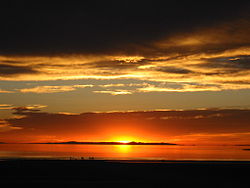
Sunset viewed from White Rock Bay, on the western shore of Antelope Island. Carrington Isle is visible in the distance.
Blackness Stone, Antelope Island, White Stone, Egg Island, Fremont Isle, and the Promontory mountain range are each extensions of the Oquirrh Mount Range, which dips beneath the lake at its southeastern shore. Stansbury, Carrington, and Hat Islands are extensions of the Stansbury mountain range, and Strongs Knob is an extension of the Lakeside Mountains which run along the lake's western shore.[23] The lake is deepest in the expanse between these island bondage, measured past Howard Stansbury in 1850 at about 35 feet (10.seven meters) deep, and an average depth of 13 anxiety (iv meters).[23] When the water levels are low, Antelope Isle becomes connected to the shore as a peninsula, as do Goose Islands, Browns Isle,[24] and some of the other islands. Stansbury Island and Strongs Knob remain peninsulas unless the h2o level rises well-above the boilerplate.
Lake-event atmospheric precipitation [edit]
Due to the warm waters of the Bang-up Table salt Lake, lake-effect snowfalls are frequent phenomena in the surrounding expanse. Cold north, north-west, or due west winds generally accident beyond the lake following the passage of a cold forepart, and the temperature difference between the warm lake and the cool air can form clouds that lead to precipitation downwind of the lake. It is typically heaviest in Tooele Canton to the due east, and n into central Davis County, and tin deposit excessive snowfall amounts, more often than not within a narrow band which is highly-dependent on the direction the wind is blowing.
The lake-effect snowfalls are more likely to occur in tardily fall, early winter and bound, due to the college temperature differences between the lake and the air in a higher place it. During summertime, the temperature differences can cause thunderstorms to form over the lake and drift eastward along the northern Wasatch Front. Some rainstorms may likewise exist partially attributed to the lake effect in fall and spring. It is estimated that approximately six to 8 lake effect snowstorms occur in a year, and that 10% of the boilerplate atmospheric precipitation of Salt Lake City can be attributed to the lake result.[25]
Hydrology [edit]
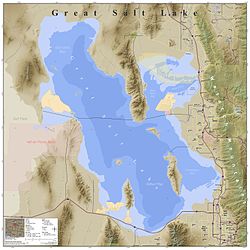
Because of its high salt concentration, the lake water is unusually dumbo, and most people tin can float more hands than in other bodies of h2o, particularly in Gunnison Bay, the saltier n arm of the lake.[26]
H2o levels have been recorded since 1875,[two] averaging about iv,200 feet (1,280 k) above ocean level. Since the Corking Common salt Lake is a shallow lake with gently sloping shores around all edges except on the south side, minor variations in the water level greatly touch on the extent of the shoreline. The h2o level can rise dramatically in moisture years and fall during dry years. The water level is also affected by the corporeality of h2o flow diverted for agronomical and urban uses. The Hashemite kingdom of jordan and Weber rivers, in detail, are diverted for other uses.[6] In the 1880s Grove Karl Gilbert predicted that the lake – then in the middle of many years of recession – would virtually disappear except for a small remnant betwixt the islands.[27]
A 2022 report used tree rings collected in the watershed of the Great Table salt Lake to create a 576-twelvemonth record of lake level reconstruction.[19] The lake level modify is strongly modulated past Pacific Bounding main coupled ocean/atmospheric oscillations at low frequency, and therefore reflects the decadal-scale moisture/dry cycles that narrate the region.[28] [29] By capturing these climate oscillations[30] too as utilizing the tree-ring reconstruction of lake level change,[31] researchers were able to predict the lake level fluctuation onward for as long as 5–8 years.[32]
The Great Table salt Lake differs in acme between the southward and north parts. The causeway for the Lucin Cutoff divides the lake into two parts. The h2o-surface elevation of the south office of the lake is usually 0.5 to 2 feet (15–61 cm) college than that of the due north part considering almost of the inflow to the lake occurs from the south.[2] [20]
Salinity [edit]
About of the salts dissolved in the lake and deposited in the desert flats effectually it reflect the concentration of solutes by evaporation; Lake Bonneville itself was fresh plenty to back up populations of fish.[33] [34] More salt is added yearly via rivers and streams, though the amount is much less than the relict table salt from Bonneville.[33]
The salinity of the lake's main basin, Gilbert Bay, is highly variable and depends on the lake'due south level; it ranges from 5 to 27% (fifty to 270 parts per thousand).[26] For comparison, the average salinity of the world ocean is 3.5% (35 parts per thousand)[35] and 33.vii% in the Dead Sea. The ionic composition is similar to seawater, much more so than the Dead Body of water's water; compared to the bounding main, Great Common salt Lake'due south waters are slightly enriched in potassium and depleted in calcium.[26] Dissolved ions exercise non necessarily increase or decrease in step with changes of total dissolved solids. For example, in October 1903 dissolved solids tallied 27.72% and by Feb 1910 they were down to 17.68% with chlorine, sodium and sulfate levels essentially lower, but over the same time calcium, magnesium and potassium increased with the increment of magnesium especially pronounced.[36]
1930s Fresh H2o Project [edit]
In the early 1930s at that place was a projection to dam off a third of the lake with dikes on the eastward side north of Salt Lake Metropolis to make a fresh water reservoir for drinking and irrigation. The project was abandoned before it got across the planning stage.[37]
Willard Bay Reservoir [edit]
Willard Bay, also known as Willard Bay Reservoir or Arthur Five. Watkins Reservoir is a fresh h2o reservoir, completed in 1964, which separated, drained, and subsequently filled with fresh water from the Weber River, a portion of the Smashing Salt Lake's northeastern arm.
West Desert Pumping Project [edit]
Record high water levels in the 1980s acquired a big amount of property damage for owners on the eastern side of the Great Salt Lake, and the water started to erode the base of operations of Interstate 80. In response, the State of Utah congenital the Westward Desert Pumping Projection on the western side of the lake. This project consists of a pumping station ( 41°15′nine.28″Northward 113°4′53.31″W / 41.2525778°Due north 113.0814750°W / 41.2525778; -113.0814750 ) at Hogup Ridge, containing three pumps with a combined chapters of moving 1,500,000 U.s. gallons per minute (95 grand3/s); an inlet canal; and an outlet canal. Also, there are 25 miles (40 km) of dikes and a 10-mile (16 km) access road between the town of Lakeside and the pumping station.[38]
This pumping project was designed to increment the expanse of the Great Table salt Lake, and thus increase the rate of water evaporation. The pumps drove some of the water of the Not bad Salt Lake into the 320,000-acre (1300-foursquare kilometer) Newfoundland Evaporation Basin in the desert west of the lake. A weir in the dike at the southern cease of the Newfoundland Mountains regulated the level of water in the basin, and it sometimes returned salty water from the evaporation basin into the main body of the Great Salt Lake.[38]
At the end of their starting time twelvemonth of operation, the pumps had removed about 500,000 acre-feet (620,000,000 kiii) of h2o from the Great Salt Lake. The project was close down in June 1989 since the level of the lake had dropped by nearly six feet (1.eight meters) since reaching its top levels during June 1986 and March 1987. The Utah Division of H2o Resource credits the project with "over one-tertiary of that decline".[38] In total, the pumps removed two,730,000 acre-feet (3.37 kmiii) of water while they operated.[39]
Although the pumps are no longer in utilize, they have been kept in place in case the level of the Great Common salt Lake e'er rises that loftier again.[40]
Ecosystem [edit]

Mountains of the Great Table salt Lake in winter.

Modern stromatolites (cyanobacteria) growing along the western shore of Antelope Isle near Elephant Caput.
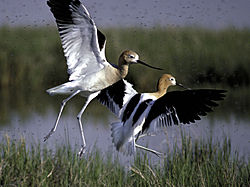
The loftier salinity in parts of the lake makes them uninhabitable for all but a few species, including brine shrimp, brine flies, and several forms of algae. The brine flies have an estimated population of over i hundred billion and serve equally the main source of food for many of the birds which migrate to the lake.[41] However, the fresh- and salt-water wetlands along the eastern and northern edges of the Groovy Table salt Lake provide critical habitat for millions of migratory shorebirds and waterfowl in western North America. These marshes account for approximately 75% of the wetlands in Utah.[42] Some of the birds that depend on these marshes include:[43] Wilson's phalarope, reddish-necked phalarope, American avocet, black-necked stilt, marbled godwit, snowy plover, western sandpiper, long-billed dowitcher, tundra swan, American white pelican, white-faced ibis, California gull, eared grebe, peregrine falcon, bald hawkeye, plus big populations of various ducks and geese.
There are twenty-seven private duck clubs, vii state waterfowl direction areas, and a big federal bird refuge on the Groovy Common salt Lake'south shores.[44] Wetland/wild animals management areas include the Bear River Migratory Bird Refuge; Gillmor Sanctuary; Great Common salt Lake Shore lands Preserve; Salt Creek, Public Shooting Grounds, Harold Crane, Locomotive Springs, Ogden Bay, Timpie Springs, and Farmington Bay Waterfowl Management Areas.
Several islands in the lake provide critical nesting areas for various birds. Admission to Hat, Gunnison, and Cub islands is strictly limited past the State of Utah in an effort to protect nesting colonies of American white pelican (Pelecanus erythrorhynchos). [45] The islands within the Great Table salt Lake also provide habitat for cadger and mammalian wild animals and a multifariousness of plant species. Some species may have been extirpated from the islands. For instance, a number of explorers who visited the expanse in the mid-1800s (due east.one thousand. Emmanuel Domenech, Howard Stansbury, Jules Rémy) noted an abundance of yellow-flowered "onions" on several of the islands, which they identified as Calochortus luteus. This species today occurs only in California, all the same, at that fourth dimension the proper noun C. luteus was applied to plants that later on were named C. nuttallii [46] [47] A yellow-flowered Calochortus was showtime named as a variety of C. nuttallii but was subsequently separated into a new species C. aureus. This species occurs in Utah today, though apparently no longer on the islands of the Great Salt Lake.[48]
Considering of the Great Table salt Lake'southward loftier salinity, it has few fish, simply they do occur in Carry River Bay and Farmington Bay when spring runoff brings fresh water into the lake. A few aquatic animals alive in the lake's main basin, including centimeter-long brine shrimp (Artemia franciscana). Their tiny, hard-walled eggs or cysts (bore about 200 micrometers)[49] are harvested in quantity during the fall and early wintertime. They are fed to prawns in Asia,[41] sold equally novelty "Sea-Monkeys," sold either live or dehydrated in pet stores every bit a fish food, and used in testing of toxins, drugs, and other chemicals.[five] There are also two species of brine fly[50] as well as protozoa, rotifers, bacteria and algae.
Salinity differences betwixt the sections of the lake separated by the railroad causeway issue in significantly different biota. A phytoplankton community dominated by dark-green algae or cyanobacteria (blueish-greenish algae) tint the h2o southward of the causeway a greenish color. North of the causeway, the lake is dominated by Dunaliella salina, a species of algae which releases beta-carotene, and the bacteria-like haloarchaea,[51] which together give the h2o an unusual reddish or purplish colour,[50] and the bacteria converts non-toxic mercury into toxic methyl mercury, which then flows into the Southern portion of the lake in a heavy brine layer through the causeway.[52]
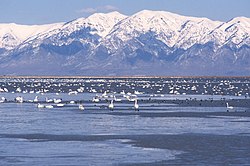
Migratory birds on the Great Salt Lake
Although brine shrimp can be found in the arm of the lake north of the causeway, studies conducted past the Utah Division of Wildlife Resource signal that these are likely transient.[51] Populations of brine shrimp are by and large restricted to the lake's south arm.
In the two bays that receive most of the lake's fresh h2o inflows, Bear River Bay and Farmington Bay, the diversity of organisms is much college. Salinities in these trophy tin can approach that of fresh h2o when the spring snow cook occurs, and this allows a variety of bacteria, algae and invertebrates to proliferate in the food-rich h2o. The affluence of invertebrates such as gnat larvae (chironomids) and back swimmers (Trichocorixa) are fed upon extensively by the huge shorebird and waterfowl populations that use the lake. Fish in these bays are fed upon past diving terns and pelicans.
Pink Floyd the flamingo [edit]
A lonely Chilean flamingo, named Pink Floyd after the English language rock band, wintered at the Keen Common salt Lake. He escaped from Salt Lake City's Tracy Aviary in 1987 and lived in the wild, eating alkali shrimp and socializing with gulls and swans. (Pinkish Floyd is often referred to as a "he", although the bird's sex activity is not actually known.)[53] A group of Utah residents suggested petitioning the state to release more flamingos in an effort to go along Floyd company and as a possible tourist attraction.[54] Wild fauna biologists resisted these efforts, maxim that deliberate introduction of a non-native species would be ecologically unsound and might have detrimental consequences.[55] Pink Floyd was last seen in Idaho, in the area of Camas National Wild animals Refuge (where he was known to drift), in 2005.[56] [57]
Elevated mercury levels [edit]
During a survey in the mid-1990s, U.S. Geological Survey and U.S. Fish and Wildlife Service researchers discovered a high level of methylmercury in the Swell Salt Lake with 25 nanograms per liter of water. For comparison, a fish consumption advisory was issued at the Florida Everglades afterward water there was found to comprise 1 nanogram per liter.[58] The extremely high methylmercury concentrations accept been only in the lake's anoxic deep brine layer (monimolimnion) below a depth of 20 anxiety (6.1 grand), merely concentrations are likewise moderately high up in the water column where in that location is oxygen to support alkali shrimp and brine flies.
The toxic metal shows up throughout the lake'due south nutrient concatenation, from brine shrimp to eared grebes and cinnamon teal.
The finding of high mercury levels prompted further studies[59] and a health informational warning hunters not to eat mutual goldeneye or northern shoveler, two species of duck found in the lake. Information technology has been stated that this does non pose a take chances to other recreational users of the lake.[60]
Afterwards later studies were conducted with a larger number of birds, the advisories were revised and another was added for cinnamon teal. Seven other species of duck were studied and found to have levels of mercury below EPA guidelines, thus being adamant safe to consume.[61]
A study in 2010 concluded that the primary source of the mercury is probable worldwide industry, rather than local sources. As water levels rise and fall, mercury accumulation does too. About 16% of the mercury is from rivers, and 84% is from the temper equally an inorganic form, which is converted into more toxic methyl mercury by bacteria which thrive in the more saline water of the Northward arm affected by the causeway.[52]
Commerce [edit]
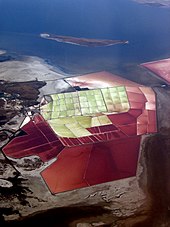
Solar evaporation ponds in the Northeast portion of the lake. Fremont Island is visible to the South (top of prototype)
Not bad Table salt Lake contributes an estimated $i.3 billion annually to Utah's economy,[62] including $1.1 billion from industry (primarily mineral extraction), $136 million from recreation, and $57 million from the harvest of brine shrimp.[63]
Solar evaporation ponds at the edges of the lake produce salts and brine (water with high salt quantity). Minerals extracted from the lake include: sodium chloride (mutual salt), used in water softeners, common salt lick blocks for livestock, and to melt water ice on local roadways (food-grade salt is not produced from the lake, as information technology would require costly processing to ensure its purity); potassium sulfate, used equally a commercial fertilizer; and magnesium-chloride alkali, used in the production of magnesium metal, chlorine gas, and equally a dust suppressant. U.s.a. Magnesium operates a plant on the southwest shore of the lake, which produces 14% of the worldwide supply of magnesium, more than whatsoever other Due north American magnesium performance.[63] Mineral-extraction companies operating on the lake pay royalties on their products to the Land of Utah, which owns the lake.[64]
The harvest of brine shrimp cysts during fall and early winter has adult into a significant local industry, with the lake providing 35% to 45% of the worldwide supply of brine shrimp,[63] and cysts selling for as high as $35 per pound ($77/kg).[65] Alkali shrimp were commencement harvested during the 1950s and sold every bit commercial fish food. In the 1970s the focus changed to their eggs, known every bit cysts, which were sold primarily exterior the U.s.a. as food for shrimp, prawns, and some fish.[49] Today, these are mostly sold in East asia and South America.[66] The amount of cysts and the quality are afflicted by several factors, but salinity is most important. The cysts will hatch at 2 to 3% salinity, merely the greatest productivity is at salinities above about ten%. If the salinity drops nigh v% to half-dozen%, the cysts volition lose buoyancy and sink, making them more than hard to harvest.[49]
The lake'south north arm contains deposits of oil, but it is of poor quality and information technology is non economically feasible to extract and purify it.[15] Every bit of 1993, approximately iii,000 barrels (480 g3) of crude oil had been produced from shallow wells along the shore.[67] The oil field at Rozel Betoken produced an estimated 10,000 barrels (1,600 m3) of oil from xxx to 50 wells, merely has been inactive since the mid-1980s. Oil seeps in the area had been known since the tardily 19th century, and attempts at production began in 1904.[68] Industrial droppings from this field remained in place nearly Spiral Jetty until a cleanup effort by the Division of Oil, Gas and Mining and the Sectionalisation of Forestry, Fire, and State Lands was completed in December 2005.[69]
Causeway [edit]
The causeway across the lake was congenital in the 1950s past the Morrison-Knudsen construction visitor for the Southern Pacific Railroad as a replacement to a previously-built wooden trestle, which was the major component of the Lucin Cutoff. The route is at present owned and operated by Marriage Pacific.[70] Almost fifteen trains cross the 20 mi (32 km) causeway each twenty-four hours.[62] Prior to December 2, 2016, the causeway constrained the flow of water between northern and southern parts, which has a significant affect on diverse industries surrounding the lake. With the structure of a 180-foot-long (55 m) bridge, creating an opening of the causeway for water to flow between the arms of the lake, water levels have begun to equalize. The full impact of the menstruum of h2o from the southern arm of the lake to the northern is nonetheless to be seen.
The northern arm of the lake has a much higher salinity, to the indicate that the native brine shrimp cannot survive in its waters. In the southern portion of the lake, where the vast bulk of the fresh water inlets are plant, the table salt level can dip below what is necessary for the brine shrimp to survive. With the opening of the bridge, the salinity of northern arm of the lake will likely drop every bit less saline water from the southern arm of the lake flows into the northern arm. The brine shrimp harvesting industry could do good from the freer menses of water.[62] There were concerns from the alkali shrimp harvesting industry that the conditions in the southern arm of the lake were condign likewise saline for the alkali shrimp, following several years of lower precipitation in the lake'south watershed. The precipitation in the watershed was to a higher place normal for the water year beginning on October 1, 2016. The additional h2o allowed the levels of both arms of the lake to rise,[xx] and at to the lowest degree for the well-nigh future the conditions for a healthy alkali shrimp population seem skillful.
Great Common salt Lake Minerals Company (a subsidiary of Compass Minerals) extracts minerals from the northern bay. The company potentially benefited from the college salinity of the north-west arm of the lake simply had difficulty accessing h2o from the lake because of lower water level. Prior to the opening of the causeway the intake channels had to exist extended to reach the h2o.
Morton Common salt, Cargill Common salt, Cleaved Arrow Salt and the Renco Group's U.South. Magnesium each extract minerals from the southern bay, and could benefit from a more natural mixture of water between the two sides of the lake.[70]
Recreation [edit]
Dramatically fluctuating lake levels have inhibited the creation and success of tourist-related developments. There is also a problem with pollution from industrial and urban effluent, equally well as a natural "lake stink" acquired past the decay of insects and other wildlife, particularly during times of low water.
Despite these issues, the lake remains one of Utah'south largest tourist attractions.[71] Antelope Isle Country Park is a popular tourist destination that offers panoramic views of the lake, hiking and biking trails, wildlife viewing and access to beaches.
The Land of Utah operates a marina on the south shore of the lake at Slap-up Salt Lake State Park, and another in Antelope Isle Land Park. With its sudden storms and expansive spread, the lake is a bang-up examination of sailing skills.[72] Single mast, uncomplicated sloops are the about pop boats. Sudden storms and lack of feel on the part of boaters are the ii most unsafe elements in boating and sailing on the Great Salt Lake.[73]
Saltair [edit]
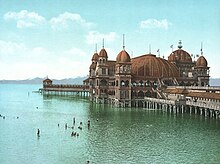
The original Saltair, c. 1900
Iii resorts, each called Saltair, have been operated on the southern shore of the lake since 1893, each 1 built as a successor to the previous 1. Rising and lowering water levels have afflicted each iteration, and the start two were destroyed past burn.[74]
The first Saltair pavilion was destroyed by fire on April 22, 1925. A new pavilion was built and the resort was expanded at the aforementioned location by new investors, just later existence closed for several years, information technology was destroyed past arson in 1970.[75]
The second Saltair included a fun house and a dancing venue.
The current Saltair serves every bit a concert venue.[76] The new resort was completed in 1981, approximately a mile (1600 m) w of the original.
Garfield Beach Resort [edit]

Garfield Beach Resort, 1888
The Garfield Beach Resort was established by Captain Thomas Douris in 1881 and was originally called Garfield Landing. Located most Black Rock outside of the boondocks of Corinne, patrons traveled to the resort via the steamboat General Garfield.[77] After the expansion of the resort, the Full general Garfield was replaced by two steamers, the Susie Riter and the Whirlwind. The iconic General Garfield was moored to the dock as a landmark.[78] The main allure of the resort was a massive pavilion 400 anxiety from shore. Information technology covered 165 by 400 feet (fifty by 122 yard) and included 300 feet (91 m) of covered deck.[78] The success of Garfield Embankment eventually overtook the neighboring Black Rock resort.[78] In 1887 the resort was purchased by the Utah and Nevada railroad. They improved the site by adding an array of bathhouses, a eating house, and other amenities similar a bowling aisle.[77] The resort was the Salt Lake's first to take an electrical generator which powered its many concerts, and parties held atop the pavilion tower.[78] Garfield Beach was the virtually pop Salt Lake resort until Saltair was built in 1893.[79] The resort was put out of service by a fire in 1904.[77] [80]
Legends and unusual features [edit]

Robert Smithson's Spiral Jetty
- Screw Jetty
- The northwest arm of the lake, near Rozel Indicate, is the location for Robert Smithson'south work of land fine art, Screw Jetty (1970), which is only visible when the level of Great Salt Lake drops below 4,197.8 feet (i,280.ii yard) above sea level.[81]
- Oolitic sand
- The lake and its shores incorporate oolitic sand, which are pocket-size, rounded, or spherical grains of sand fabricated up of a nucleus (more often than not a small mineral grain) and concentric layers of calcium carbonate (lime) and wait similar to very minor pearls.[82]
- Whales in the Great Salt Lake
- Local fable maintains that in 1875, entrepreneur James Wickham had two whales released into the Great Salt Lake, with the intent of using them equally a tourist allure.[83] [84] The whales are said to have disappeared into the lake and subsequently sighted multiple times over a number of months, but there have never been whatsoever confirmed sightings of the whales since the fourth dimension of their supposed release.[85]
- Lake monster
- In mid-1877, J.H. McNeil was with many other Barnes and Co. Salt Works employees on the lake'southward due north shore in the evening. They claimed to have seen a large monster with a body similar a crocodile and a horse's head in the lake. They claimed this monster attacked the men, who quickly ran abroad and hid until morning. This creature is regarded past some to have simply been a buffalo in the lake. Thirty years prior, "Blood brother Bainbridge" claimed to have sighted a creature that looked like a dolphin in the lake near Antelope Island. This monster is called by some the North Shore Monster.[xv]
Meet too [edit]
- List of lakes by surface area
- Pyramid Lake
- Neopluvial
- Mono Lake
- Salar de Uyuni
References [edit]
- ^ a b "Corking Table salt Lake". Encyclopædia Britannica Online. Archived from the original on February 17, 2007. Retrieved June 18, 2006.
- ^ a b c d e f "Dandy Salt Lake, Utah". United states Geological Survey. Archived from the original on May 6, 2009. Retrieved April 12, 2009.
- ^ "Great Table salt Lake Reaches New Historic Low". USGS. U.S. Department of the Interior. Retrieved July 24, 2021.
- ^ Arave, Lynn. "Great Salt Lake: A Lively Recreational Jewel". Deseret News. Archived from the original on March 21, 2006.
- ^ a b "Birds and Cracking Salt Lake". United States Geological Survey. Archived from the original on July 13, 2013. Retrieved June nineteen, 2006.
- ^ a b c d Morgan (1947), p. 22.
- ^ Arnow, T (1984). "Water-level and water-quality changes in Great Salt Lake, Utah, 1847–1983". U.S. Geological Survey Round 913. Washington, DC: U.s. Geological Survey.
- ^ Madsen, Brigham (1985). The Shoshoni Frontier and the Bear River Massacre. University of Utah Printing. p. half-dozen. ISBN978-0-87480-494-ii.
- ^ Chamberlin, Ralph Five. (1913). "Identify and Personal Names of the Gosiute Indians of Utah, Folio 12". Proceedings of the American Philosophical Society. 52 (208): ane–xx. JSTOR 983995.
- ^ Chamberlin, Ralph 5. (1913). "Place and Personal Names of the Gosiute Indians of Utah, Page nine". Proceedings of the American Philosophical Gild. 52 (208): 1–20. JSTOR 983995.
- ^ File:Insel Kalifornien 1650.jpg
- ^ Encyclopedia Britannica. Vol. 10. 1971.
- ^ Stansbury, Howard (1852). Exploration and survey of the valley of the Great Salt Lake of Utah. Lippincott, Grambo & Co. p. 1. Retrieved January 23, 2010.
stansbury survey bully salt lake.
- ^ Carter, Lyndia (June 1996). "Guano Sifters on Gunnison Island". History Blazer. Utah Land Historical Society. Archived from the original on Oct 16, 2013. Retrieved October 30, 2013.
- ^ a b c Arave, Lynn. "Smashing Tales Surrounding the Great Common salt Lake". Deseret News. Archived from the original on June 21, 2006. Retrieved July 28, 2006.
- ^ "Conduct Lake" (PDF). Utah Segmentation of Water Quality. Archived from the original (PDF) on July 24, 2006. Retrieved July 24, 2006.
- ^ Wang, S.-Y.; Gillies, R. R.; Jin, J. & Hipps, 50. Eastward. (2010). "Coherence betwixt the Smashing Table salt Lake level and the Pacific quasi-decadal oscillation". Journal of Climate. Vol. 23. pp. 2161–2177.
- ^ Gillies, R. R.; Chung, O.-Y.; Wang, S.-Y. & Kokoszka, P. (2011). "Incorporation of Pacific SSTs in a fourth dimension series model towards a longer-term forecast for the Keen Salt Lake elevation". Periodical of Hydrometeorology. Vol. 12. pp. 474–480.
- ^ a b DeRose, R. Justin; Wang, Shih-Yu; Buckley, Brendan M. & Bekker, Matthew F. (2014). "Tree-ring reconstruction of the level of Great Salt Lake, United states". The Holocene. Vol. 24, no. 7. pp. 805–813. doi:10.1177/0959683614530441.
- ^ a b c "USGS Surface-Water Daily Data for the Nation". U.s. Geological Survey. Archived from the original on September 21, 2017. Retrieved April 30, 2017.
- ^ Hassible & Keck (1993), pp. 11–12.
- ^ "Commonly Asked Questions About Utah'southward Dandy Salt Lake and Aboriginal Lake Bonneville". Utah Geological Survey. p. 05. Archived from the original on August 27, 2013. Retrieved June 26, 2011.
- ^ a b Morgan (1947), pp. 18–19.
- ^ "Utah Islands". Archived from the original on October 3, 2018. Retrieved September 21, 2017.
- ^ Bauman, Joe. "Lake has great impact on storms, weather". Deseret Morning News. Archived from the original on October 2, 2012.
- ^ a b c "Tin can I float in Corking Salt Lake?". Utah Geological Survey. Archived from the original on August 15, 2010.
- ^ Morgan (1947), p. 23.
- ^ "Multidecadal Drought Cycles in the Peachy Basin Recorded by the Great Salt Lake: Modulation from a Transition-Phase Teleconnection". Journal of Climate. Vol. 25. pp. 1711–1721. doi:ten.1175/2011JCLI4225.i.
- ^ "Coherence between the Cracking Common salt Lake Level and the Pacific Quasi-Decadal Oscillation". Journal of Climate. Vol. 23. pp. 2161–2177. doi:10.1175/2009JCLI2979.1.
- ^ "Incorporation of Pacific SSTs in a Fourth dimension Series Model toward a Longer-Term Forecast for the Great Table salt Lake Top". Journal of Hydrometeorology. Vol. 12. pp. 474–480. doi:10.1175/2010JHM1352.1.
- ^ "Added value from 576 years of tree-ring records in the prediction of the Not bad Salt Lake level". Periodical of Hydrology. Vol. 529. pp. 962–968. doi:ten.1016/j.jhydrol.2015.08.058.
- ^ "Great Salt Lake Almanac Level Prediction". Utah Climate Center. Archived from the original on September 22, 2015. Retrieved November 12, 2015.
- ^ a b "Commonly Asked Questions Well-nigh Utah'due south Great Salt Lake and Ancient Lake Bonneville". Utah Geological Survey. p. 3. Archived from the original on Apr 22, 2008. Retrieved September 21, 2017.
- ^ "Commonly Asked Questions About Utah's Cracking Salt Lake and Ancient Lake Bonneville". Utah Geological Survey. p. 02. Archived from the original on February 19, 2008. Retrieved September 21, 2017.
- ^ "Sea Water: Salinity". Archived from the original on March vi, 2012. Retrieved July 31, 2007.
- ^ https://pubs.acs.org/doi/abs/10.1021/ie50023a005 W.C. Ebaugh and Wallace MacFarlane. Comparative Analyses Of Water From Bully Common salt Lake. The Periodical of Industrial and Technology Chemical science, November 1910, folio 454
- ^ "Aim To Change Not bad Salt Lake Into Fresh Water". Popular Science. May 1932.
- ^ a b c Hassible & Keck (1993), p. 22.
- ^ "Fact Sheet: West Desert Pumping Projection". Utah Division of Water Resource. Archived from the original on Baronial 27, 2013. Retrieved Baronial 23, 2006.
- ^ "Great Common salt Lake Pumping Project". Utah Division of Water Resources. Archived from the original on August 27, 2013. Retrieved August 9, 2006.
- ^ a b "Bully Salt Lake Facts". Utah.com. Archived from the original on July ii, 2014. Retrieved August 4, 2006.
- ^ "Utah Wetlands Interpretive Network". Utah Wetlands Interpretive Network. Archived from the original on June 19, 2006.
- ^ "Great Table salt Lake, UT: What Shorebird Species Use This Site?". Manomet Center for Conservation Sciences. Archived from the original on December eighteen, 2005.
- ^ "Utah's Dandy Salt Lake: An Undervalued Resource". Friends of Bully Common salt Lake. Archived from the original on November iv, 2004.
- ^ "R657-15: Closure of Gunnison, Cub and Hat Islands". Utah Partition of Wildlife Resources. Archived from the original on March 11, 2006.
- ^ Hogan, C. Michael (2009). Stromberg, N. (ed.). "Yellow Mariposa Lily: Calochortus luteus". GlobalTwitcher.com. Archived from the original on October 4, 2011.
- ^ Fiedler, P. (1993). "Calochortus". Flora of North America North of Mexico. Vol. 26. Zebell. Flora of North America Editorial Committee.
- ^ Shultz, Fifty.Thousand.; Ramsey, R. D.; Lindquist, W. & Garrard, C. (2010). "Digital Atlas of the Vascular Plants of Utah". Utah Country University. Archived from the original on December 11, 2012. Retrieved August 7, 2012.
- ^ a b c "Brine Shrimp and Ecology of Not bad Salt Lake". Usa Geological Survey. Archived from the original on March 11, 2015. Retrieved August fourteen, 2005.
- ^ a b "Life in the Great Common salt Lake". Weber State University Department of Botany. Archived from the original on September five, 2006. Retrieved August four, 2006.
- ^ a b "North Arm (Gunnison Bay)". Utah Partitioning of Wildlife Resource. Archived from the original on July 13, 2006. Retrieved Baronial four, 2006.
- ^ a b Hollenhorst, John. "Report says mercury in Great Salt Lake is global problem". KSL. Archived from the original on October 29, 2013. Retrieved Oct 27, 2013.
- ^ "Could Pink Floyd Exist Sick". KSL. Archived from the original on September 30, 2007. Retrieved September 7, 2007. .
- ^ Speckman, Stephen (January 12, 2004). "Floyd may get some pink feathered friends". Deseret News. Archived from the original on October 4, 2013. Retrieved October 3, 2013.
- ^ "A Flamingo Flies the Coop to Fame". The Christian Scientific discipline Monitor. Archived from the original on May fifteen, 2006. Retrieved January 2, 2020.
- ^ "Feeling Blueish About Pink Floyd". Deseret News. Archived from the original on October 4, 2013. Retrieved October 3, 2013.
- ^ "Reader Tips". Roadside America. Archived from the original on December 23, 2007.
- ^ "Toxic mercury lurking in Not bad Salt Lake". Common salt Lake Tribune. Archived from the original on December 23, 2007. Retrieved November 29, 2007.
- ^ "Utah Waterfowl Advisory". Utah Office of Epidemiology. Archived from the original on September 24, 2006. Retrieved August 25, 2006.
- ^ "High mercury levels found in two duck species" (Press release). Utah Division of Wildlife Resources. Archived from the original on February 1, 2010. Retrieved August 25, 2006.
- ^ "Duck mercury advisories revised" (Printing release). Utah Division of Wildlife Resource. Archived from the original on Jan seven, 2010. Retrieved September 21, 2006.
- ^ a b c Fahys, Judy. "Great Salt Lake causeway sinks, prompting emergency repairs". The Salt Lake Tribune. Archived from the original on November 2, 2012. Retrieved Nov 21, 2012.
- ^ a b c Fahys, Judy. "Great Table salt Lake an economic powerhouse for the state". Salt Lake Tribune. Archived from the original on November ten, 2016. Retrieved Oct 28, 2013.
- ^ "What minerals are produced from Corking Salt Lake?". Utah Geological Survey. Archived from the original on November 8, 2010. Retrieved Baronial 11, 2006.
- ^ LaRoe, Lisa Moore. "Table salt Lake Valley's Leap of Faith". National Geographic. Archived from the original on October 11, 2007. Retrieved August 11, 2006.
- ^ "South Arm (Gilbert Bay)". Utah Division of Wildlife Resources. Archived from the original on July 13, 2006. Retrieved August 12, 2006.
- ^ Hassible & Keck (1993), p. twenty.
- ^ Milligan, Marking. "'Bubblin' Crude' at Rozel Point, Box Elder County, Utah". Utah Geological Survey. Archived from the original on March 23, 2011. Retrieved November 21, 2012.
- ^ Milligan, Mark. "Rozel Point and Screw Jetty Revisited, Box Elder Canton, Utah". Utah Geological Survey. Archived from the original on August 27, 2013. Retrieved Nov 21, 2012.
- ^ a b Hollenhorst, John. "Union Pacific causeway upgrade proposal could change colors of the Great Table salt Lake". Deseret News. Archived from the original on October 29, 2013. Retrieved November 21, 2012.
- ^ "Great Salt Lake". www.visitutah.com . Retrieved Nov 2, 2021.
- ^ Stum, Marlin & Miller, Dan (1999). Visions of Antelope Island and Great Salt Lake. Utah State University Press. p. 4. ISBN978-0-87421-269-3. Archived from the original on May 12, 2016. Retrieved September 3, 2009.
- ^ Cherny, Peter Chiliad. (1976). The Great Great Salt Lake. Provo, UT: Brigham Young University Press. p. 4. ISBN978-0-8425-1073-8. Archived from the original on May 12, 2016. Retrieved September three, 2009 – via Google Books.
- ^ Strack, Don. "Salt Lake, Garfield & Western Railway". Archived from the original on November xxx, 2011. Retrieved April 14, 2011.
- ^ "Saltair". Utah History Encyclopedia. Archived from the original on May one, 2011. Retrieved April xiv, 2011.
- ^ "Saltair Resort". Utah City Guide. Archived from the original on April 27, 2006. Retrieved June 19, 2006.
- ^ a b c "Resorts flourished at Cracking Common salt Lake during the 1800s". Deseret News. March 29, 1998. Archived from the original on August 14, 2017. Retrieved June 9, 2017.
- ^ a b c d Morgan, Dale (1995). The Great Salt Lake. Salt Lake City: University of Utah Press.
- ^ "Great Table salt Lake Beaches". Tooele County Guide to Historical Attractions. Archived from the original on September 21, 2017. Retrieved June 9, 2017.
- ^ Ison, Yvette. "The Steamboat Era Was Glamorous But Very Brief in Utah". historytogo.utah.gov. Archived from the original on July 21, 2017. Retrieved June ix, 2017.
- ^ Case, William F. "Pink Water, White Table salt Crystals, Black Boulders, and the Return of Screw Jetty!". Utah Geological Survey. Archived from the original on May 6, 2008.
- ^ "What are the round, white sand grains that make up the beaches?". Utah Geological Survey. Archived from the original on September 27, 2006. Retrieved August 25, 2006.
- ^ "The University of Utah". biologylabs.utah.edu. Archived from the original on September xx, 2017. Retrieved September 21, 2017.
- ^ Phoenix Roberts (January 26, 2006). "Whale of a tale". sltrib.com. Archived from the original on September 21, 2017. Retrieved September 21, 2017.
- ^ Twila Van Leer (Oct 3, 1995). "WHALE OF A SALTY TALE SWIMS THROUGH PAGES OF Sometime Paper". Deseret News. Archived from the original on June 28, 2018. Retrieved May half-dozen, 2018.
Works cited [edit]
- Hassible, West.R. & Keck, W.Chiliad. (1993). The Great Salt Lake. Washington, DC: Government Printing Part. 1993 0 – 337–928 : QL 2.
- Morgan, Dale L. (1947). The Nifty Salt Lake. Common salt Lake City: University of Utah Printing. ISBN978-0-87480-478-two.
External links [edit]
| External images | |
|---|---|
 map (FWS.gov) map (FWS.gov) | |
| map (Friends of GSL | |
| map (USGS.gov) | |
| daily surface level | |
| volume & area vs surface level | |
| photographic survey | |
| NASA images | |
| inquiry images (Westminster edu) | |
| boating images (UTAH.com) | |
| gulls |
gonzalezbegaind00.blogspot.com
Source: https://en.wikipedia.org/wiki/Great_Salt_Lake
0 Response to "Now and Again Salt Lake City Ut"
Post a Comment