China Awarding People Percentage Points for Bad Behavior to Hold Again Them
/https://tf-cmsv2-smithsonianmag-media.s3.amazonaws.com/filer/cd/ee/cdee1c82-f8e3-4de4-983e-8599d4485745/finland-smiles-wr.jpg)
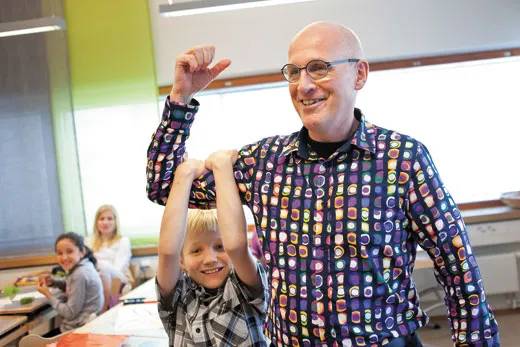
It was the end of term at Kirkkojarvi Comprehensive School in Espoo, a sprawling suburb west of Helsinki, when Kari Louhivuori, a veteran teacher and the school's chief, decided to try something extreme—by Finnish standards. One of his 6th-form students, a Kosovo-Albanian male child, had drifted far off the learning filigree, resisting his teacher'south best efforts. The schoolhouse's squad of special educators—including a social worker, a nurse and a psychologist—convinced Louhivuori that laziness was not to blame. So he decided to agree the boy back a year, a measure so rare in Finland it's practically obsolete.
Finland has vastly improved in reading, math and science literacy over the past decade in large part because its teachers are trusted to do any information technology takes to turn young lives around. This xiii-yr-onetime, Besart Kabashi, received something akin to royal tutoring.
"I took Besart on that year as my private pupil," Louhivuori told me in his function, which boasted a Beatles "Yellow Submarine" poster on the wall and an electric guitar in the closet. When Besart was not studying scientific discipline, geography and math, he was parked next to Louhivuori's desk at the front of his class of 9- and ten-year- olds, cracking open books from a alpine stack, slowly reading ane, then another, so devouring them by the dozens. By the end of the twelvemonth, the son of Kosovo war refugees had conquered his adopted land's vowel-rich language and arrived at the realization that he could, in fact, learn.
Years afterward, a 20-year-onetime Besart showed upwards at Kirkkojarvi's Christmas political party with a canteen of Cognac and a large grinning. "You lot helped me," he told his former instructor. Besart had opened his own car repair firm and a cleaning company. "No big fuss," Louhivuori told me. "This is what we practise every day, prepare kids for life."
This tale of a unmarried rescued child hints at some of the reasons for the tiny Nordic nation's staggering record of educational activity success, a phenomenon that has inspired, baffled and even irked many of America's parents and educators. Finnish schooling became an unlikely hot topic afterwards the 2010 documentary film Waiting for "Superman" assorted it with America'southward troubled public schools.
"Whatever information technology takes" is an attitude that drives not just Kirkkojarvi'due south 30 teachers, but most of Finland's 62,000 educators in three,500 schools from Lapland to Turku—professionals selected from the height x per centum of the nation'southward graduates to earn a required primary's degree in education. Many schools are small enough so that teachers know every student. If one method fails, teachers consult with colleagues to try something else. They seem to relish the challenges. Almost 30 percent of Finland's children receive some kind of special help during their commencement 9 years of school. The schoolhouse where Louhivuori teaches served 240 first through ninth graders final year; and in contrast with Republic of finland'south reputation for ethnic homogeneity, more than than half of its 150 uncomplicated-level students are immigrants—from Somalia, Republic of iraq, Russia, Bangladesh, Republic of estonia and Ethiopia, among other nations. "Children from wealthy families with lots of pedagogy tin can be taught past stupid teachers," Louhivuori said, smiling. "We effort to catch the weak students. It's deep in our thinking."
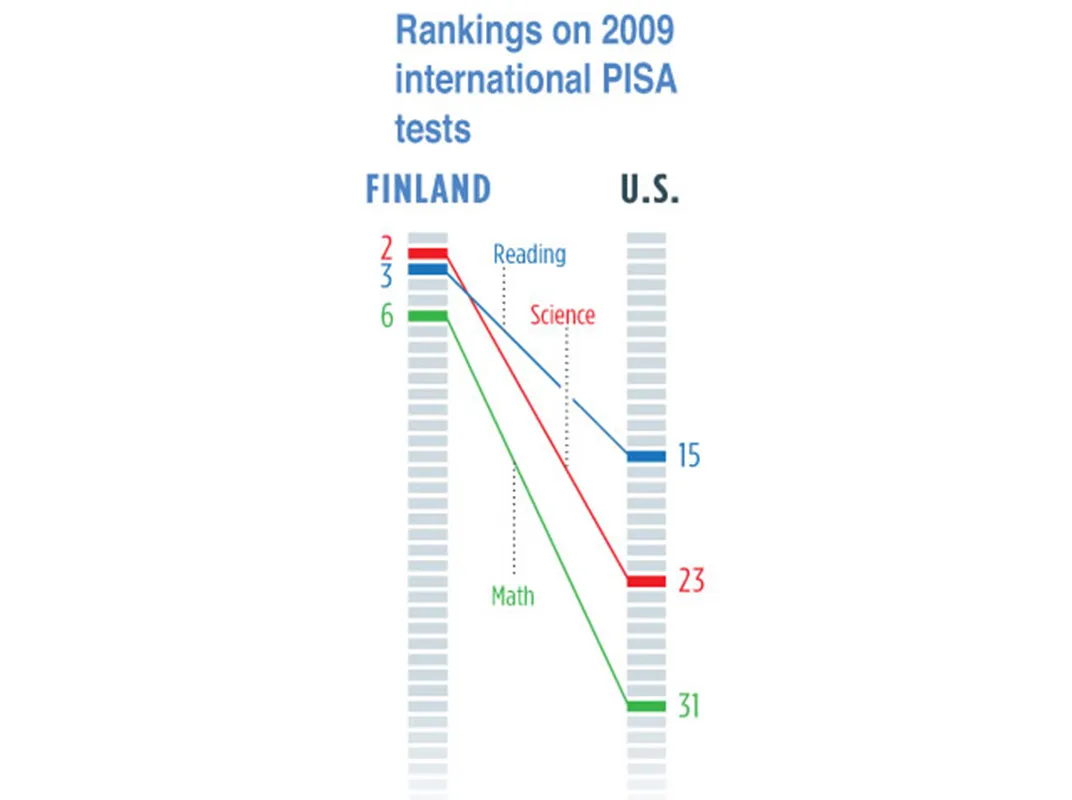
The transformation of the Finns' teaching system began some 40 years ago equally the key propellent of the country'southward economical recovery programme. Educators had little idea it was and so successful until 2000, when the first results from the Plan for International Student Assessment (PISA), a standardized test given to 15-year-olds in more than than forty global venues, revealed Finnish youth to be the all-time young readers in the world. Three years after, they led in math. Past 2006, Republic of finland was first out of 57 countries (and a few cities) in science. In the 2009 PISA scores released last year, the nation came in second in science, third in reading and sixth in math among nearly half a million students worldwide. "I'm still surprised," said Arjariita Heikkinen, principal of a Helsinki comprehensive schoolhouse. "I didn't realize we were that good."
In the United States, which has muddled along in the middle for the by decade, authorities officials have attempted to introduce market competition into public schools. In recent years, a group of Wall Street financiers and philanthropists such equally Bill Gates have put money behind private-sector ideas, such equally vouchers, information-driven curriculum and lease schools, which have doubled in number in the past decade. President Obama, too, has plainly bet on competition. His Race to the Pinnacle initiative invites states to compete for federal dollars using tests and other methods to measure teachers, a philosophy that would non wing in Finland. "I recall, in fact, teachers would tear off their shirts," said Timo Heikkinen, a Helsinki principal with 24 years of teaching feel. "If you but mensurate the statistics, you miss the human aspect."
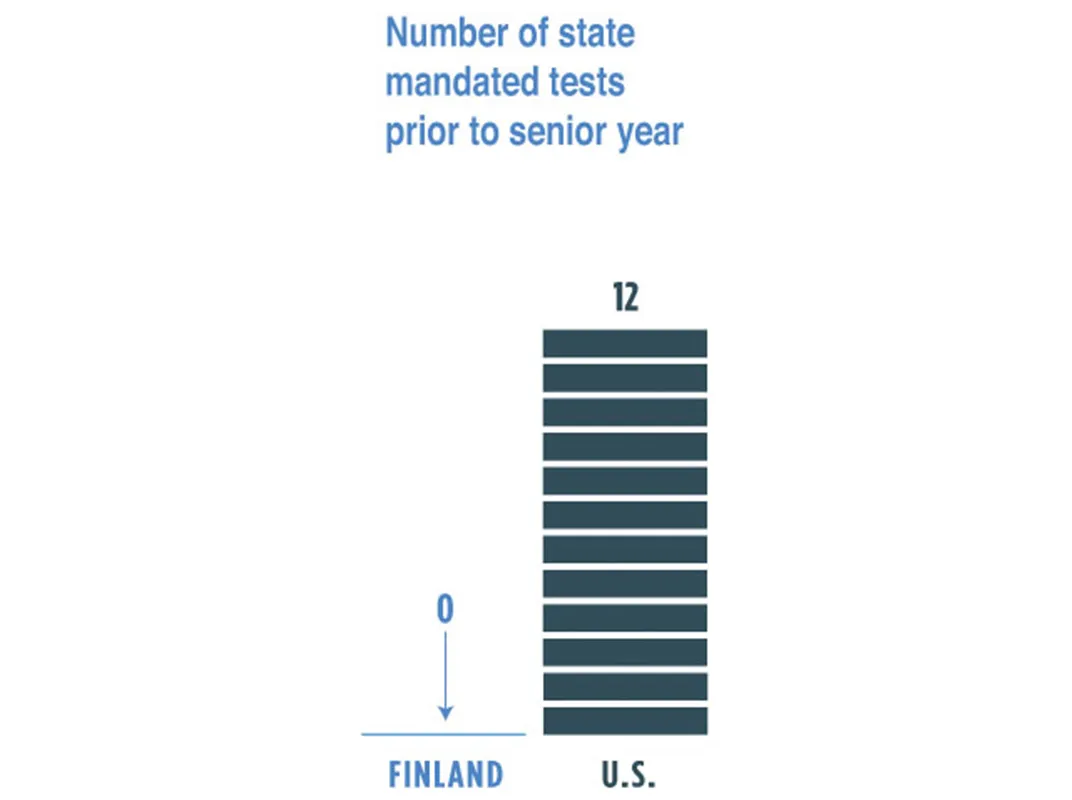
There are no mandated standardized tests in Finland, autonomously from i exam at the stop of students' senior year in high school. There are no rankings, no comparisons or competition betwixt students, schools or regions. Republic of finland's schools are publicly funded. The people in the government agencies running them, from national officials to local authorities, are educators, not business people, military leaders or career politicians. Every school has the same national goals and draws from the same pool of university-trained educators. The consequence is that a Finnish child has a proficient shot at getting the same quality education no matter whether he or she lives in a rural village or a university boondocks. The differences betwixt weakest and strongest students are the smallest in the world, according to the virtually recent survey by the Arrangement for Economic Co-operation and Development (OECD). "Equality is the nigh important word in Finnish education. All political parties on the right and left concord on this," said Olli Luukkainen, president of Finland'southward powerful teachers marriage.
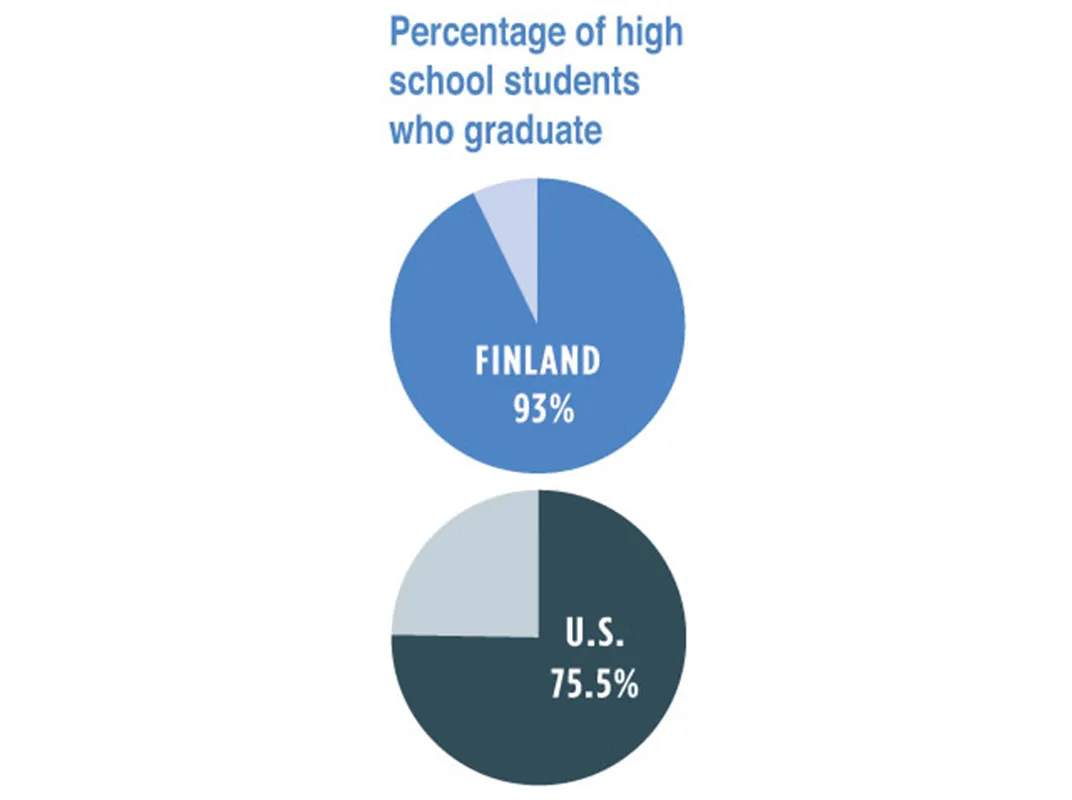
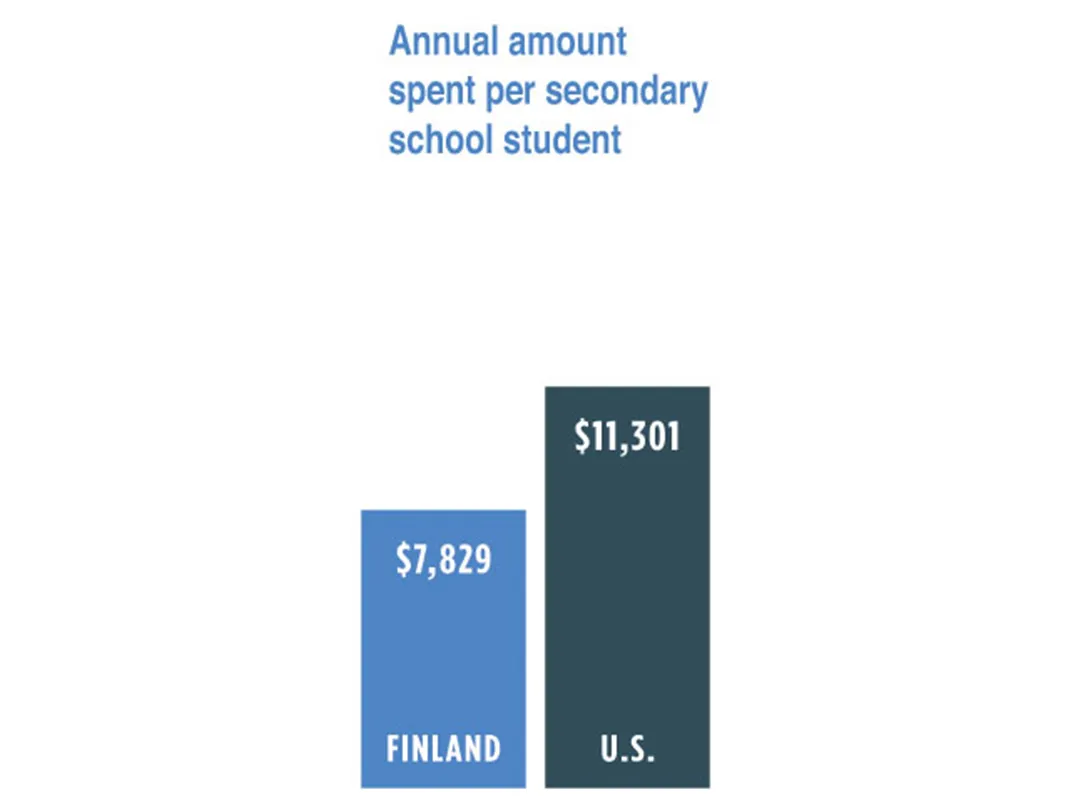
Ninety-iii percent of Finns graduate from bookish or vocational high schools, 17.5 percentage points higher than the The states, and 66 percentage go on to higher education, the highest rate in the European Union. Withal Finland spends nigh 30 percent less per student than the The states.
Still, there is a distinct absenteeism of chest-thumping amongst the famously reticent Finns. They are eager to celebrate their recent world hockey title, but PISA scores, not and so much. "We fix children to learn how to learn, non how to accept a test," said Pasi Sahlberg, a former math and physics instructor who is now in Finland'due south Ministry of Instruction and Culture. "We are not much interested in PISA. It'due south not what nosotros are about."
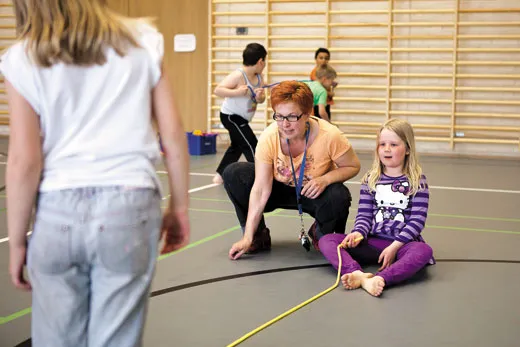
Maija Rintola stood before her chattering class of twenty-3 7- and viii-year-olds one belatedly April day in Kirkkojarven Koulu. A tangle of multicolored threads topped her copper pilus like a painted wig. The twenty-year teacher was trying out her look for Vappu, the twenty-four hour period teachers and children come to school in riotous costumes to gloat May Day. The morning time sun poured through the slate and lemon linen shades onto containers of Easter grass growing on the wooden sills. Rintola smiled and held up her open paw at a camber—her time-tested "silent giraffe," which signaled the kids to be quiet. Picayune hats, coats, shoes stowed in their cubbies, the children wiggled side by side to their desks in their stocking feet, waiting for a turn to tell their tale from the playground. They had only returned from their regular 15 minutes of playtime outdoors between lessons. "Play is important at this age," Rintola would later say. "Nosotros value play."
With their wiggles unwound, the students took from their desks little bags of buttons, beans and laminated cards numbered 1 through 20. A teacher's aide passed effectually yellow strips representing units of ten. At a smart board at the front of the room, Rintola ushered the class through the principles of base of operations x. One girl wore true cat ears on her caput, for no apparent reason. Some other kept a blimp mouse on her desk to remind her of dwelling house. Rintola roamed the room helping each child grasp the concepts. Those who finished early played an advanced "nut puzzle" game. After twoscore minutes it was fourth dimension for a hot lunch in the cathedral-like cafeteria.
Teachers in Republic of finland spend fewer hours at school each twenty-four hours and spend less fourth dimension in classrooms than American teachers. Teachers employ the extra time to build curriculums and appraise their students. Children spend far more than time playing outside, even in the depths of winter. Homework is minimal. Compulsory schooling does not begin until historic period 7. "Nosotros have no hurry," said Louhivuori. "Children learn amend when they are ready. Why stress them out?"
Information technology'south almost unheard of for a child to show up hungry or homeless. Republic of finland provides three years of motherhood go out and subsidized twenty-four hours care to parents, and preschool for all 5-yr-olds, where the emphasis is on play and socializing. In improver, the state subsidizes parents, paying them around 150 euros per month for every child until he or she turns 17. Xc-vii percent of 6-year-olds attend public preschool, where children begin some academics. Schools provide nutrient, medical intendance, counseling and taxi service if needed. Student health care is free.
Notwithstanding, Rintola said her children arrived last August miles autonomously in reading and language levels. By April, virtually every child in the class was reading, and most were writing. Boys had been coaxed into literature with books similar Kapteeni Kalsarin ("Captain Underpants"). The school's special education instructor teamed up with Rintola to teach v children with a variety of behavioral and learning issues. The national goal for the past five years has been to mainstream all children. The only time Rintola'due south children are pulled out is for Finnish equally a Second Language classes, taught by a teacher with xxx years' feel and graduate school preparation.
In that location are exceptions, though, however rare. One first-class girl was not in Rintola's class. The wispy 7-year-old had recently arrived from Thailand speaking not a word of Finnish. She was studying math down the hall in a special "preparing grade" taught by an good in multicultural learning. Information technology is designed to help children keep up with their subjects while they conquer the language. Kirkkojarvi's teachers take learned to bargain with their unusually large number of immigrant students. The city of Espoo helps them out with an extra 82,000 euros a year in "positive discrimination" funds to pay for things like special resource teachers, counselors and six special needs classes.
Rintola will teach the same children side by side yr and possibly the side by side five years, depending on the needs of the school. "Information technology'southward a adept system. I can brand strong connections with the children," said Rintola, who was handpicked by Louhivuori 20 years ago. "I understand who they are." Also Finnish, math and science, the get-go graders have music, art, sports, religion and textile handcrafts. English begins in tertiary grade, Swedish in 4th. By fifth class the children have added biological science, geography, history, physics and chemistry.
Non until sixth grade will kids have the option to sit for a district-wide exam, and then simply if the classroom teacher agrees to participate. Most do, out of curiosity. Results are not publicized. Finnish educators have a hard time understanding the United States' fascination with standardized tests. "Americans like all these bars and graphs and colored charts," Louhivuori teased, as he rummaged through his closet looking for past years' results. "Looks similar we did better than boilerplate ii years ago," he said later he found the reports. "Information technology's nonsense. We know much more than about the children than these tests can tell u.s.."
I had come to Kirkkojarvi to see how the Finnish approach works with students who are non stereotypically blond, blue-eyed and Lutheran. But I wondered if Kirkkojarvi's success confronting the odds might be a fluke. Some of the more vocal conservative reformers in America have grown weary of the "We-Love-Finland oversupply" or and then-called Finnish Envy. They fence that the United states of america has fiddling to larn from a country of simply 5.four 1000000 people—4 percentage of them strange built-in. All the same the Finns seem to exist onto something. Neighboring Norway, a state of similar size, embraces instruction policies similar to those in the U.s.a.. It employs standardized exams and teachers without principal's degrees. And like America, Norway'south PISA scores have been stalled in the eye ranges for the meliorate part of a decade.
To get a second sampling, I headed east from Espoo to Helsinki and a rough neighborhood called Siilitie, Finnish for "Hedgehog Road" and known for having the oldest low-income housing projection in Finland. The 50-year-quondam boxy schoolhouse edifice sat in a wooded area, around the corner from a subway stop flanked by gas stations and convenience stores. Half of its 200 starting time- through ninth-form students take learning disabilities. All merely the well-nigh severely dumb are mixed with the general education children, in keeping with Finnish policies.
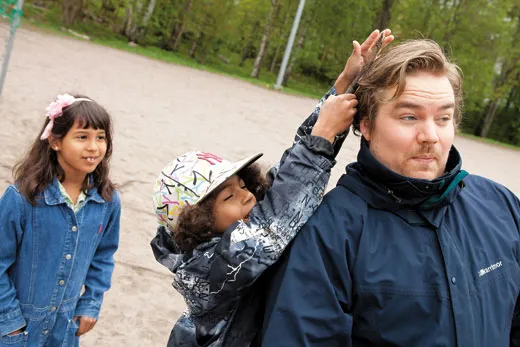
A class of outset graders scampered among nearby pino and birch trees, each holding a stack of the teacher's bootleg laminated "outdoor math" cards. "Find a stick as big equally your pes," ane read. "Gather l rocks and acorns and lay them out in groups of x," read another. Working in teams, the 7- and 8-twelvemonth-olds raced to meet how quickly they could carry out their tasks. Aleksi Gustafsson, whose master'southward caste is from Helsinki University, developed the practise later attention 1 of the many workshops bachelor free to teachers. "I did research on how useful this is for kids," he said. "Information technology'due south fun for the children to work outside. They really larn with it."
Gustafsson's sis, Nana Germeroth, teaches a grade of mostly learning-impaired children; Gustafsson's students have no learning or behavioral issues. The two combined well-nigh of their classes this year to mix their ideas and abilities along with the children's varying levels. "We know each other actually well," said Germeroth, who is ten years older. "I know what Aleksi is thinking."
The school receives 47,000 euros a year in positive bigotry money to hire aides and special education teachers, who are paid slightly college salaries than classroom teachers because of their required sixth year of academy preparation and the demands of their jobs. There is ane instructor (or assistant) in Siilitie for every vii students.
In another classroom, ii special education teachers had come up with a unlike kind of squad educational activity. Terminal year, Kaisa Summa, a teacher with five years' experience, was having trouble keeping a gaggle of first-grade boys under control. She had looked longingly into Paivi Kangasvieri's quiet 2nd-grade room side by side door, wondering what secrets the 25-year-veteran colleague could share. Each had students of wide-ranging abilities and special needs. Summa asked Kangasvieri if they might combine gymnastics classes in hopes good behavior might exist contagious. Information technology worked. This twelvemonth, the two decided to merge for 16 hours a week. "We complement each other," said Kangasvieri, who describes herself equally a calm and firm "male parent" to Summa'due south warm mothering. "It is cooperative instruction at its best," she says.
Every so often, principal Arjariita Heikkinen told me, the Helsinki commune tries to close the school because the surrounding expanse has fewer and fewer children, simply to take people in the community ascension up to save it. Later all, nearly 100 percent of the school's ninth graders go on to high schools. Even many of the most severely disabled will notice a place in Finland's expanded system of vocational high schools, which are attended past 43 per centum of Finnish high-school students, who fix to work in restaurants, hospitals, construction sites and offices. "We help situate them in the right high school," said then deputy principal Anne Roselius. "Nosotros are interested in what will become of them in life."
Republic of finland'southward schools were non e'er a wonder. Until the late 1960s, Finns were all the same emerging from the cocoon of Soviet influence. Most children left public school later on six years. (The rest went to private schools, academic grammar schools or folk schools, which tended to be less rigorous.) Only the privileged or lucky got a quality pedagogy.
The landscape changed when Finland began trying to remold its encarmine, fractured past into a unified time to come. For hundreds of years, these fiercely independent people had been wedged betwixt ii rival powers—the Swedish monarchy to the west and the Russian czar to the east. Neither Scandinavian nor Baltic, Finns were proud of their Nordic roots and a unique linguistic communication only they could honey (or pronounce). In 1809, Finland was ceded to Russia by the Swedes, who had ruled its people some 600 years. The czar created the Grand Duchy of Finland, a quasi-state with constitutional ties to the empire. He moved the capital from Turku, virtually Stockholm, to Helsinki, closer to St. petersburg. After the czar fell to the Bolsheviks in 1917, Finland declared its independence, pitching the country into ceremonious war. Three more wars betwixt 1939 and 1945—two with the Soviets, ane with Federal republic of germany—left the state scarred by bitter divisions and a punishing debt owed to the Russians. "Still we managed to proceed our freedom," said Pasi Sahlberg, a director general in the Ministry of Teaching and Culture.
In 1963, the Finnish Parliament fabricated the assuming decision to choose public teaching as its all-time shot at economic recovery. "I call this the Big Dream of Finnish education," said Sahlberg, whose upcoming book,Finnish Lessons, is scheduled for release in Oct. "It was just the thought that every child would have a very skillful public school. If we desire to be competitive, nosotros need to educate everybody. It all came out of a need to survive."
Practically speaking—and Finns are nothing if not practical—the determination meant that goal would not be allowed to dissipate into rhetoric. Lawmakers landed on a deceptively unproblematic plan that formed the foundation for everything to come. Public schools would be organized into i organisation of comprehensive schools, orperuskoulu, for ages vii through 16. Teachers from all over the nation contributed to a national curriculum that provided guidelines, not prescriptions. As well Finnish and Swedish (the land'due south second official linguistic communication), children would learn a third language (English is a favorite) usually beginning at historic period ix. Resources were distributed equally. Every bit the comprehensive schools improved, and so did the upper secondary schools (grades 10 through 12). The 2d critical decision came in 1979, when reformers required that every teacher earn a fifth-year primary's degree in theory and do at one of eight state universities—at country expense. From then on, teachers were effectively granted equal status with doctors and lawyers. Applicants began flooding teaching programs, not because the salaries were and so high but considering autonomy and respect made the chore bonny. In 2010, some half dozen,600 applicants vied for 660 principal school preparation slots, according to Sahlberg. By the mid-1980s, a final set of initiatives shook the classrooms free from the last vestiges of top-downwardly regulation. Control over policies shifted to town councils. The national curriculum was distilled into broad guidelines. National math goals for grades 1 through ix, for example, were reduced to a smashing ten pages. Sifting and sorting children into then-called power groupings was eliminated. All children—clever or less so—were to be taught in the same classrooms, with lots of special teacher help available to make sure no child really would be left behind. The inspectorate airtight its doors in the early '90s, turning accountability and inspection over to teachers and principals. "We have our ain motivation to succeed because we love the work," said Louhivuori. "Our incentives come from within."
To exist sure, it was only in the by decade that Finland'due south international science scores rose. In fact, the country's earliest efforts could exist called somewhat Stalinistic. The first national curriculum, developed in the early on '70s, weighed in at 700 stultifying pages. Timo Heikkinen, who began teaching in Finland's public schools in 1980 and is at present master of Kallahti Comprehensive School in eastern Helsinki, remembers when almost of his high-school teachers saturday at their desks dictating to the open notebooks of compliant children.
And there are however challenges. Finland'southward crippling financial plummet in the early '90s brought fresh economic challenges to this "confident and assertive Eurostate," as David Kirby calls it inA Curtailed History of Finland. At the same time, immigrants poured into the country, clustering in low-income housing projects and placing added strain on schools. A contempo written report by the Academy of Finland warned that some schools in the country's large cities were becoming more skewed past race and form as flush, white Finns choose schools with fewer poor, immigrant populations.
A few years ago, Kallahti chief Timo Heikkinen began noticing that, increasingly, affluent Finnish parents, perhaps worried near the ascension number of Somali children at Kallahti, began sending their children to one of two other schools nearby. In response, Heikkinen and his teachers designed new environmental science courses that take reward of the schoolhouse's proximity to the wood. And a new biology lab with three-D engineering science allows older students to observe blood flowing inside the man trunk.
It has even so to take hold of on, Heikkinen admits. Then he added: "Simply we are ever looking for ways to improve."
In other words, whatever it takes.
gonzalezbegaind00.blogspot.com
Source: https://www.smithsonianmag.com/innovation/why-are-finlands-schools-successful-49859555/
0 Response to "China Awarding People Percentage Points for Bad Behavior to Hold Again Them"
Post a Comment